Vermont Yankee After Closure: Decommissioning Nears the Finish Line
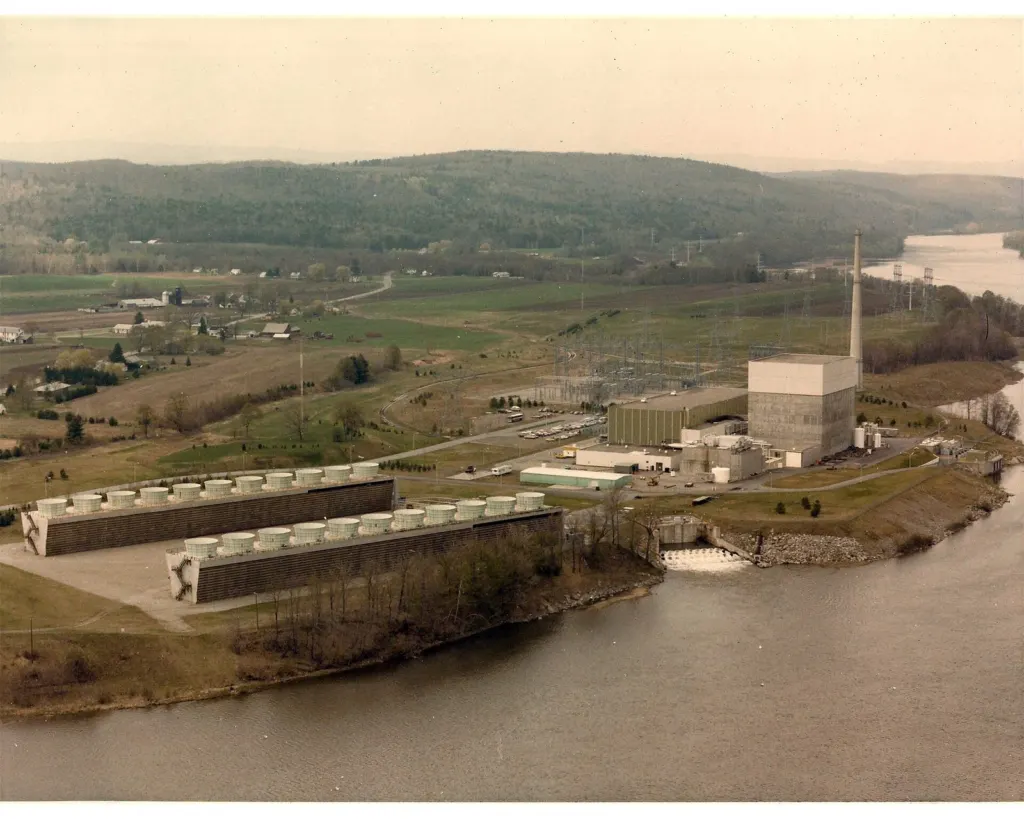
Vermont Yankee Nuclear Power Station in Vernon, Vermont, before decommissioning. Photo: Nuclear Regulatory Commission from US / Wikimedia Commons, CC BY 2.0.
For more than four decades, the Vermont Yankee Nuclear Power Station in Vernon, on the Connecticut River in the state’s southeast corner, was one of Vermont’s most important and most argued-over facilities. It supplied a large share of the state’s electricity, employed hundreds of people and paid significant taxes. It also became the focus of a long political and legal fight over whether it should keep running.
In 2026, the plant is almost gone. Here’s how that happened and what’s left.
Four decades of operation
Vermont Yankee began commercial operation in 1972. It was a boiling-water reactor, and for many years it produced roughly a third of the electricity used in Vermont. Entergy bought it in 2002.
The relicensing fight
In the 2000s, debate grew over the plant’s future as its original 40-year federal license neared its 2012 expiration. Business groups and many residents valued its low-carbon, relatively low-cost power and its jobs. Critics pointed to its age, waste storage and a series of problems, including the collapse of part of a cooling tower in 2007 and leaks of tritium-contaminated water discovered in 2010.
Vermont was unusual in giving its Legislature a role in approving continued operation. In 2010 the state Senate voted against allowing the plant to keep running past 2012. The Nuclear Regulatory Commission granted a 20-year federal license extension in 2011. Entergy sued the state, and a federal court ruled in 2012 that parts of Vermont’s laws were preempted by federal authority over nuclear safety.
Shutdown
In August 2013, Entergy announced it would close the plant, citing economics, chiefly low wholesale power prices driven by cheap natural gas. Vermont Yankee stopped producing power on Dec. 29, 2014.
The sale to NorthStar
Under the usual approach, called “SAFSTOR,” a closed plant can sit for decades before full dismantling. Instead, in 2019 Entergy transferred the plant and its decommissioning trust fund to NorthStar Group Services, after approval by federal regulators and the Vermont PUC. NorthStar committed to finishing decommissioning much sooner, with a target of 2030 or earlier.
Where things stand in 2026
According to NorthStar updates to the state’s Nuclear Decommissioning Citizens Advisory Panel and reporting by VTDigger in September 2026, physical decommissioning is about 99% complete. Major structures have been dismantled, and radioactive components and low-level waste have been shipped off-site. Physical work is expected to finish in 2027, ahead of the 2030 commitment.
Work remaining includes backfilling, riverbank restoration and removal of the plant’s water discharge structure. The NRC must also review final site surveys before releasing the land from its license, a process that can take around two years.
The spent fuel
One part of Vermont Yankee won’t leave soon: its spent nuclear fuel. It’s stored in steel-and-concrete dry casks on a secured pad at the site, as at many retired U.S. reactors, because the federal government has not opened a permanent repository or an interim storage site. Until it does, the fuel will remain in Vernon, under NRC oversight.
The economic aftermath
The closure took hundreds of well-paid jobs out of the Brattleboro–Vernon region and cut a large source of tax revenue, especially for Vernon. State and regional groups, including the Brattleboro Development Credit Corporation, used economic development funds from Entergy to support workforce training and business growth in Windham County. Town leaders have discussed future uses for the site once it’s released.
Lessons for Vermont’s energy future
Vermont Yankee’s closure changed the state’s power supply. Vermont utilities now rely heavily on contracts with Hydro-Québec, regional purchases and in-state renewables, and since 2017 they’ve worked under the Renewable Energy Standard. Learn more in our explainers on Vermont’s renewable and clean heat rules and solar at Vermont businesses. For business groups’ role in energy debates, see our profile of the Vermont Chamber of Commerce. More in Energy & Environment.
Key dates
- 1972: Vermont Yankee begins commercial operation in Vernon.
- 2002: Entergy buys the plant.
- 2007: Part of a cooling tower collapses, raising maintenance concerns.
- 2010: Tritium leaks are discovered, and the Vermont Senate votes against continued operation past 2012.
- 2011: The NRC grants a 20-year license extension. Entergy sues Vermont.
- 2013: Entergy announces it will close the plant.
- Dec. 29, 2014: The plant stops generating electricity.
- 2019: Ownership transfers to NorthStar for accelerated decommissioning.
- 2026: Physical decommissioning is about 99% complete, according to NorthStar.
Sources
- U.S. Nuclear Regulatory Commission, Vermont Yankee decommissioning: https://www.nrc.gov/info-finder/decommissioning/power-reactor/vermont-yankee.html
- Vermont Department of Public Service, decommissioning status updates (Feb. 2026): https://publicservice.vermont.gov/
- VTDigger, “Vermont Yankee decommissioning is nearly complete,” Sept. 23, 2026: https://vtdigger.org/2026/09/23/vermont-yankee-decommissioning-is-nearly-complete/