Solar Power at Vermont Businesses: Where Things Stand
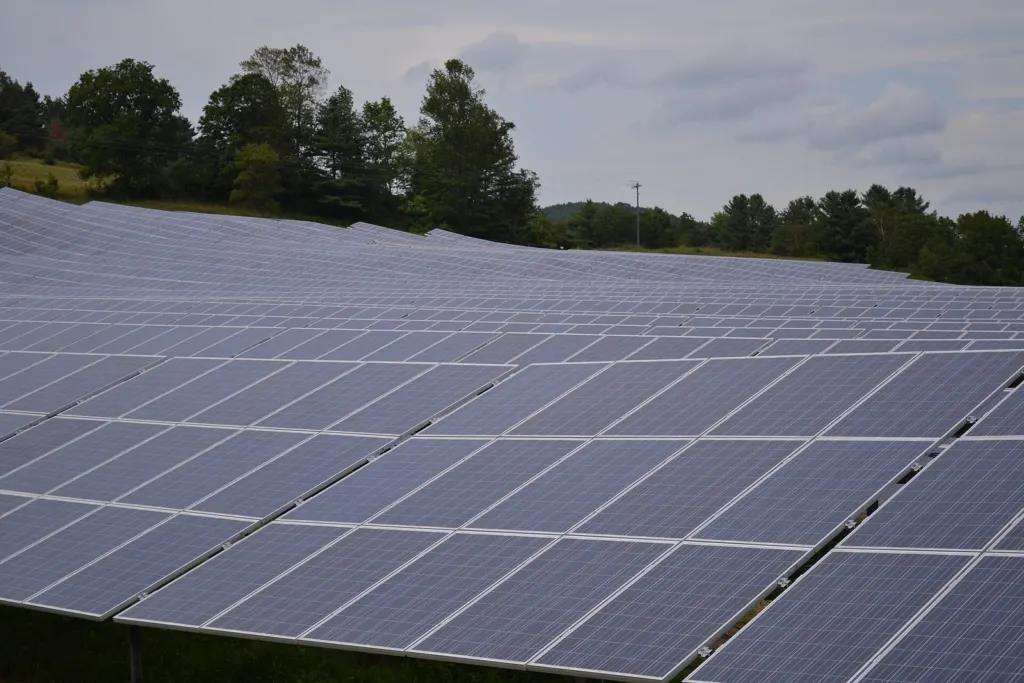
Rows of ground-mounted solar panels at a solar array in Sharon, Vermont. Photo: SayCheeeeeese / Wikimedia Commons, CC0.
More than 15 years ago, a commercial solar array on a Vermont company’s roof was unusual enough to make news. One well-known early example was Green Mountain Coffee Roasters, the Waterbury company later folded into Keurig Dr Pepper, which installed panels at its facilities in 2009. Since then, solar has become a standard line item in many Vermont businesses’ energy plans, along with farms, schools, municipalities and housing developers.
This guide explains how commercial solar works in Vermont today, what the state’s energy laws require of utilities, and what a business should check before installing panels.
How business solar connects to the grid
Most Vermont business systems are grid-connected and use net metering. The utility credits the customer for electricity the system produces and sends to the grid, and those credits offset what the business draws at other times.
The rules are set by the Vermont Public Utility Commission (PUC), which reviews them every two years. As solar costs fell, the PUC lowered the compensation for new net-metered systems and adjusted incentives to favor projects on rooftops, parking lots, landfills and other “preferred sites” over open farmland. Act 179 of 2024 also tightened group net metering: since 2025, new group systems generally have to be on or adjacent to the property they serve, with a temporary exception for affordable housing.
Businesses should read their utility’s current net-metering tariff closely. Compensation, siting adjustments and the treatment of renewable energy credits (RECs) can significantly change a project’s economics.
What Vermont law requires of utilities
Vermont’s Renewable Energy Standard (RES), in place since 2017, requires electric utilities to get a set share of their supply from renewable sources. Act 179 raised those requirements sharply. According to the PUC:
- Utilities had to source at least 63% renewable energy in 2025, rising each year.
- Most utilities must reach 100% renewable by 2030. Municipal utilities and GlobalFoundries’ utility, GF Power, have until 2035.
- New tiers require utilities to buy new regional renewable energy and to meet much of their load growth with new renewables.
- Green Mountain Power, the state’s largest utility, must get a growing share from new in-state distributed renewables. That share reaches 20% by 2035.
This matters to businesses because utilities now compete for in-state renewable projects to meet those requirements. That can create partnership opportunities: some companies lease rooftops or land to developers instead of owning a system.
Siting and permits
Larger solar projects need a Certificate of Public Good from the PUC. Towns and regional planning commissions can weigh in, and plans that meet state standards earn “substantial deference” in siting decisions. Screening, setbacks, wildlife and agricultural soils can all come up. Rooftop and parking-canopy systems usually face fewer siting hurdles.
Incentives and financing
Common starting points include:
- Federal tax incentives for commercial clean energy. Rules and phase-outs have changed in recent federal legislation, so confirm current eligibility with a tax advisor.
- USDA’s Rural Energy for America Program (REAP), which offers grants and loan guarantees to agricultural producers and rural small businesses for renewable energy and efficiency.
- Efficiency Vermont, which doesn’t fund solar panels directly but can help a business cut energy use first, often the cheaper step.
- Financing from VEDA, local banks and community lenders (see our guide to small business financing).
Batteries and resilience
After repeated storms and floods, more Vermont businesses are pairing solar with battery storage. Green Mountain Power runs battery programs that can provide backup power to customers while letting the utility draw on stored energy during peak demand. For businesses that can’t afford outages, such as food processors, health providers and lodging, storage is becoming part of the conversation.
Questions to ask before installing
- How much electricity do we use, and when? (Get 12 months of utility data.)
- Is our roof in good condition and oriented well? Does it need replacing first?
- What does our utility’s current net-metering tariff pay for exported power?
- Who keeps the renewable energy credits, and how does that affect any “renewable” marketing claims?
- What’s the payback with and without incentives, and what are the maintenance costs?
Related coverage
See our explainer on Vermont’s climate and clean heat laws, our look at wood pellet heating, and the history of Vermont Yankee, the nuclear plant that once supplied much of the state’s power. More in Energy & Environment and Business.
Sources
- Vermont Public Utility Commission, Renewable Energy Standard: https://puc.vermont.gov/electric/renewable-energy-standard
- Vermont Public Utility Commission, net metering: https://puc.vermont.gov/electric/net-metering
- Act 179 of 2024, summary and text: https://legislature.vermont.gov/Documents/2024/Docs/ACTS/ACT179/ACT179%20Act%20Summary.pdf
- USDA Rural Energy for America Program: https://www.rd.usda.gov/programs-services/energy-programs/rural-energy-america-program-renewable-energy-systems-energy-efficiency-improvement-guaranteed-loans
- Efficiency Vermont: https://www.efficiencyvermont.com/