Eurasian Watermilfoil in Missisquoi Bay: How Vermont Fights Invasive Plants
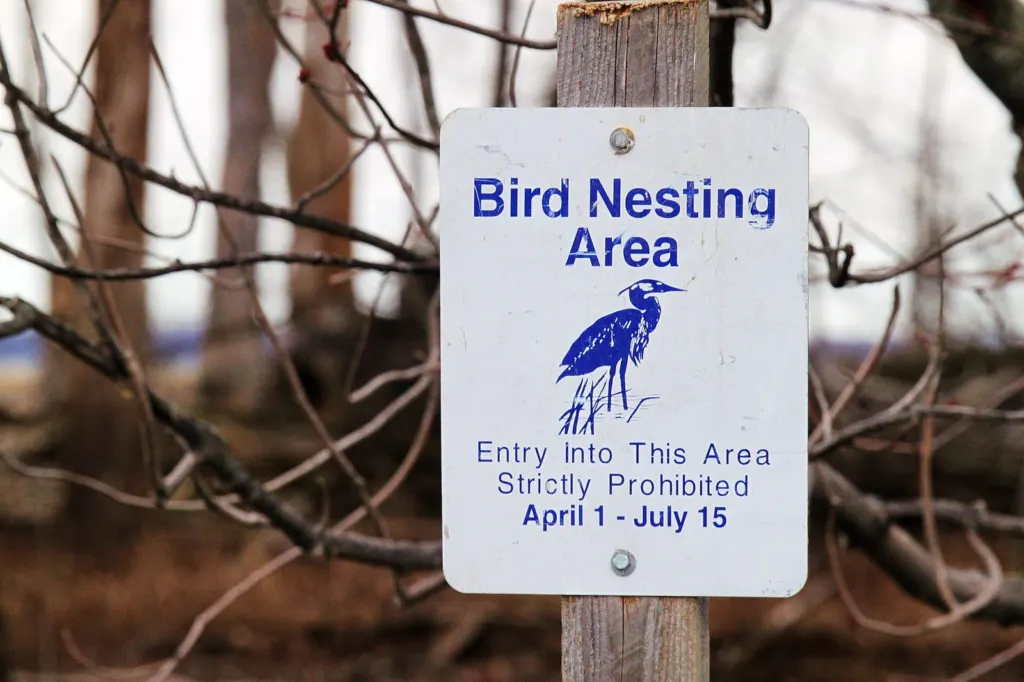
Sign marking a great blue heron nesting area at Missisquoi National Wildlife Refuge in Swanton, Vermont. Photo: U. S. Fish and Wildlife Service - Northeast Region / Wikimedia Commons, Public domain.
At the northern tip of Lake Champlain, Missisquoi Bay straddles the border between Vermont and Quebec. It’s shallow, it warms quickly in summer, and it takes in water from the Missisquoi River, which drains farms, forests and towns in northern Vermont and southern Quebec. Those features make the bay productive for fish and wildlife. They also make it one of the parts of the lake most vulnerable to cyanobacteria blooms and to aquatic invasive species.
Among the invasive plants that have long worried lake managers is Eurasian watermilfoil. Here’s what it is, why it matters and how Vermont tries to contain it.
What Eurasian watermilfoil is
Eurasian watermilfoil (Myriophyllum spicatum) is a submerged aquatic plant native to Europe, Asia and North Africa. It has feathery leaves arranged in whorls around the stem, usually with 12 or more leaflet pairs per leaf. That’s one way biologists tell it apart from Vermont’s native milfoils, which tend to have fewer.
The plant grows from the lake bottom toward the surface. In shallow, nutrient-rich water it can form dense mats that:
- crowd out native plants that fish and waterfowl rely on,
- tangle boat propellers and make swimming unpleasant,
- reduce oxygen as large masses of plant material die and decay,
- and can lower shoreline property values and recreation use.
How it spreads
Eurasian watermilfoil spreads mainly by fragmentation. A small piece of stem can root and start a new colony. Boats, trailers, anchors, fishing gear and even paddles can carry fragments from one water body to another. That’s why prevention focuses on people moving between lakes.
Vermont’s rules
Vermont law prohibits transporting aquatic plants, aquatic plant parts or aquatic invasive species on the outside of a vehicle, boat, personal watercraft, trailer or other equipment. Before you leave an access area, you’re expected to remove any plants or animals and dispose of them away from the water.
The state’s message for boaters and anglers is Clean, Drain, Dry:
- Clean off all plants, animals and mud from the boat, trailer and gear.
- Drain all water from the motor, bilge, live wells and bait buckets before leaving the access area.
- Dry everything thoroughly, ideally for several days, before launching in a different water body.
Greeters and decontamination
The Vermont Department of Environmental Conservation (DEC) supports the Vermont Public Access Greeter Program. Through it, trained greeters at boat launches inspect watercraft, explain the rules and record what they find. At some sites, free decontamination stations use hot water to clean boats and gear. Greeter programs are often run with local lake associations and towns, with state grant support.
Management in infested waters
Where watermilfoil is established, eradication is usually unrealistic, so managers aim for control. Common methods include:
- Hand-pulling and diver-assisted suction harvesting, which remove plants and roots in targeted areas.
- Benthic barriers, mats laid on the lake bottom to block light.
- Mechanical harvesting of surface mats.
- Herbicide treatments, which require state permits and review.
Each approach has trade-offs in cost, effectiveness and effects on native plants. DEC’s Aquatic Invasive Species program helps lake groups plan and fund these efforts.
The bigger picture in Missisquoi Bay
Invasive plants aren’t the only pressure on Missisquoi Bay. Its biggest long-term problem is phosphorus pollution, which feeds summer cyanobacteria blooms. Vermont, Quebec and federal partners have worked on that issue for decades through the Lake Champlain Basin Program and a federal phosphorus cleanup plan. Read our explainer on Lake Champlain water quality for more.
The bay is also part of the Missisquoi National Wildlife Refuge area in Swanton, an important habitat for migrating birds.
How you can help
- Follow Clean, Drain, Dry every time you move between water bodies.
- Learn to recognize common invasives such as Eurasian watermilfoil, water chestnut and zebra mussels.
- Report suspected new infestations to DEC’s Aquatic Invasive Species program.
- Support or volunteer with your local lake association’s greeter and monitoring efforts.
For more Lake Champlain coverage, see our guide to winter wind sports on the lake, and browse Energy & Environment and Local News.
Sources
- Vermont DEC, Aquatic Invasive Species program: https://dec.vermont.gov/watershed/lakes-ponds/aquatic-invasives
- Vermont DEC, Public Access Greeter Program: https://dec.vermont.gov/watershed/lakes-ponds/aquatic-invasives/greeter
- Lake Champlain Basin Program, aquatic invasive species: https://www.lcbp.org/
- U.S. Fish & Wildlife Service, Missisquoi National Wildlife Refuge: https://www.fws.gov/refuge/missisquoi