Barre’s North End Gets $4.2 Million for Flood Buyouts and 17 New Homes on Higher Ground
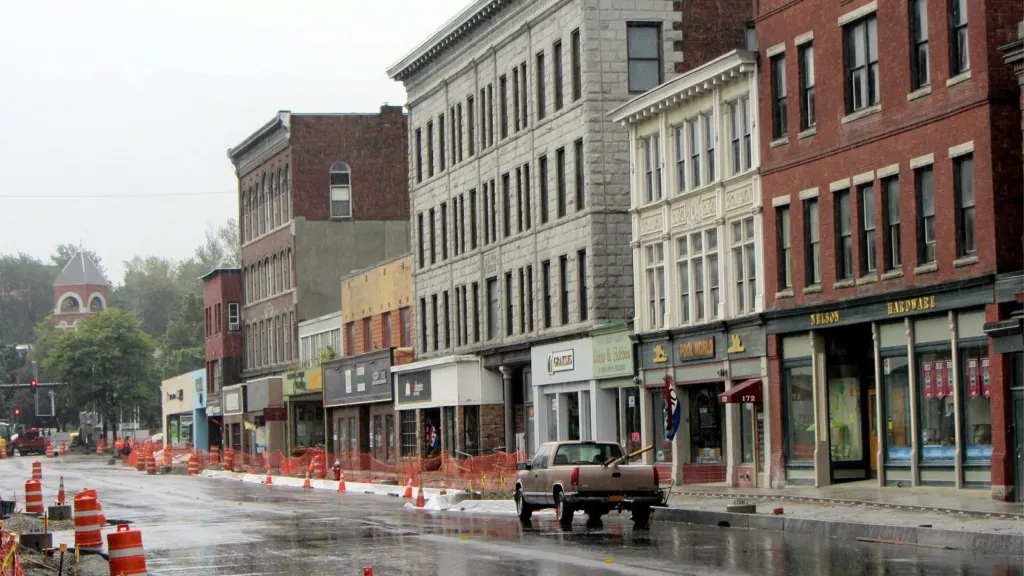
Photo: David Wilson, CC BY 2.0, via Wikimedia Commons.
More than three years after the July 2023 floods tore through Barre City’s North End, the neighborhood has a funded plan to rebuild some of what was lost, on higher ground.
Gov. Phil Scott returned to his hometown on Oct. 15 to announce a $4,243,069 federal disaster recovery grant for the city’s North End Buyouts and Housing project. The award is the last piece of the roughly $68 million in Community Development Block Grant Disaster Recovery money Congress set aside for Vermont’s 2023 flood recovery.
What the money will pay for
The project has two parts that are meant to work together, according to the state’s announcement.
First, Wobby Park, a city-owned playground and park next to Barre’s public safety building, will become the site of 17 new townhomes. The land sits just outside the flood zone. Barre City Mayor Thom Lauzon told Vermont Public the city plans to sell the parcel to the developers for $1.
Second, the grant will pay for buyouts of three flood-prone properties across the street, two commercial and one residential, including two on North Main Street. Those buildings will be torn down and the land returned to green space. The city then plans to build a new park on that site to replace Wobby Park.
“When floodwater devastated Barre, especially here in the North End, it was clear rebuilding in the same place didn’t make any sense because as we all know, it’s going to flood again,” Scott said in the announcement.
The homes
The developers are local contractors Trym Chouinard and Eric Lajeunesse, Vermont Public reported. The two-bedroom townhomes will be built in a factory in East Montpelier by modular homebuilder Huntington Homes and then set on site.
Because of the federal rules attached to this kind of disaster money, the homes will be sold at subsidized prices to qualified buyers. Chouinard told Vermont Public the target sale price is $270,000, and that buyers will also receive down payment assistance, with the amount still being worked out. He said he expects to break ground in May 2027.
The homes are not specifically reserved for people displaced by the floods, Vermont’s chief recovery officer, Douglas Farnham, told the station, though disaster case managers will help connect flood survivors with the new options.
A smaller plan than first proposed
The award is a scaled-back version of the North End redevelopment Scott floated a few months after the 2023 flood, which envisioned demolishing buildings near the river, restoring floodplain and building hundreds of new homes on higher ground. That plan stalled for years, and the neighborhood flooded again in July 2024.
“It isn’t as grand as I had originally hoped, but it’s still going to be impactful to this region and this part of the city, in particular,” Scott said at the Oct. 15 press conference, as reported by Vermont Public.
The city applied twice before for federal recovery money for the area, focusing on buyouts and flood storage, Lauzon told the station. Adding new housing to the application helped it succeed on the third try. He also cautioned that the townhomes are only a first step: “We probably need to replicate this project four or five more times in order to bring meaningful recovery to the North End,” he said.
Where the statewide recovery money went
In all, Vermont awarded $67,845,000 in CDBG-DR funds to 28 projects in three rounds, according to the governor’s office. The first round, announced in December 2025, totaled nearly $50 million. A second round of $10.2 million followed in April 2026. The Barre grant closes out the program’s awards.
The money came through the American Relief Act of 2025, passed by Congress in December 2024, and is administered by the Vermont Community Development Program within the Agency of Commerce and Community Development. It is limited to the areas the U.S. Department of Housing and Urban Development designated as most impacted and distressed: Lamoille, Washington, Caledonia, Orleans, Rutland, Windham and Windsor counties.
Unlike most Federal Emergency Management Agency aid, which typically pays to repair damaged homes or buy out flood-prone ones, this money can help communities create new housing where none existed. Vermont Public reported that the state has used it for infrastructure to support new homes on higher ground in Plainfield and Montpelier, for converting a vacant Vermont State University building in Johnson into housing, and for a replacement bridge in Cabot designed for higher water. Two other Barre housing projects also received funds.
What it means for Barre
Barre has been one of the hardest-hit communities in Vermont’s recent floods, and losing flooded buildings also means losing property tax base. Central Vermont Recovery Officer Patricia Moulton said 28 Barre City properties have already gone through the buyout process, with more underway, according to Vermont Public. Scott said the federal recovery money is expected to support about 139 new homes in the city overall.
For North End residents, the near-term changes will be visible: a park that moves across the street, three buildings coming down, and a cluster of new homes on higher ground beside the public safety building. Whether that becomes the start of a larger rebuild, as the mayor hopes, will depend on future funding.
Sources
- Office of Governor Phil Scott, “Governor Phil Scott Announces Final CDBG-DR Flood Recovery Award,” Oct. 15, 2026: governor.vermont.gov
- Vermont Public, “Barre wins flood recovery funds for long-awaited North End housing,” Oct. 15, 2026: vermontpublic.org
- Agency of Commerce and Community Development, CDBG-DR Awards: accd.vermont.gov