Broadband Expansion in Rural Vermont: How Communications Union Districts Work
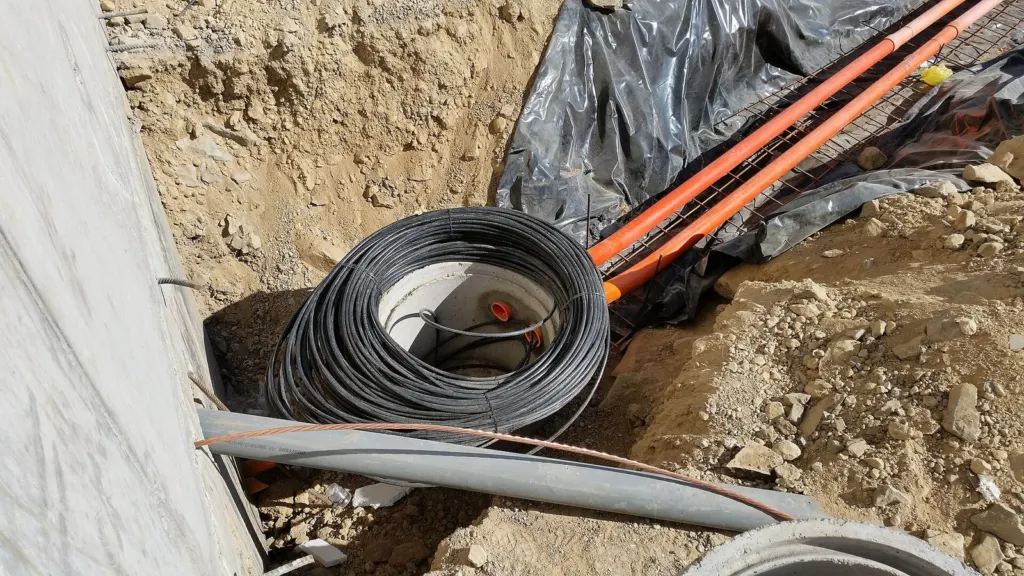
Fiber-optic cable being installed in a trench (illustrative). Photo: Rubin Observatory/NSF/AURA / Wikimedia Commons, CC BY 4.0.
For years, a large share of rural Vermont homes had slow DSL, unreliable satellite service or no home internet at all. Private providers often found it unprofitable to run lines down long dirt roads to a handful of houses. The pandemic made the gap impossible to ignore, as remote work, school and telehealth moved online.
Vermont’s main answer has been a homegrown model: Communications Union Districts (CUDs).
What a CUD is
A Communications Union District is a municipal entity formed by two or more towns to build and operate communications infrastructure, usually fiber-optic broadband. Towns join by a vote of residents at town meeting or, in some cases, by selectboard vote. Each member town appoints representatives to the district’s governing board.
Key features of the model:
- No town tax liability. Under Vermont law, CUDs can’t levy taxes, and member towns’ taxpayers aren’t liable for a district’s debts. That’s a lesson partly drawn from the troubles of Burlington Telecom.
- Revenue bonds and grants. Districts finance construction through grants, loans and bonds repaid from subscriber revenue.
- Partnerships. Many CUDs contract with private operators to build, run or provide service on their networks.
The model began with ECFiber, formed by towns in east-central Vermont in the late 2000s, and spread statewide after a 2015 law clarified how CUDs could form.
How many and where
According to the Vermont Community Broadband Board (VCBB)‘s January 2026 report to lawmakers, Vermont has nine CUDs covering 216 towns. Together they cover most of the state outside areas already well served. Earlier materials listed more districts, but some have since merged, including the combination of NEK Broadband and CVFiber.
Districts include ECFiber in east-central Vermont, along with districts serving the Northeast Kingdom, central Vermont, the southern part of the state, the Champlain Valley, Lamoille County and other regions. Each district’s website shows its member towns and build-out maps.
Funding
CUD construction has been financed through several sources:
- Federal pandemic relief (ARPA) funds, which the Legislature directed largely to CUDs through VCBB grants starting in 2021–2022.
- State grants and loans administered by the VCBB.
- Federal BEAD funding. The Broadband Equity, Access, and Deployment program, created by the 2021 federal infrastructure law, is the final major source. In February 2026, the federal government approved Vermont’s BEAD final proposal, unlocking about $93 million. State officials say the plan would bring broadband access to more than 99% of Vermonters.
- Revenue bonds and private financing.
Progress and challenges
CUDs and their partners have built thousands of miles of fiber and connected tens of thousands of locations. Challenges have included:
- Utility pole “make-ready” work: preparing poles to carry new fiber has been slow and costly.
- Construction costs and supply chain delays.
- Remote locations, where each connection is expensive.
- Sustainability: networks must sign up enough subscribers to cover operating costs and debt.
For residents
- Find your CUD: the VCBB website lists districts and member towns.
- Check the build-out map to see when fiber is planned or available at your address.
- Pre-register or sign up. Strong sign-up rates help a district plan and finance construction.
- Ask about low-income programs. Some providers offer discounted plans.
Why it matters
Reliable broadband affects where people can live and work, whether rural businesses can sell online, and access to telehealth and education. It’s closely tied to Vermont’s workforce and small business challenges.
More in News.
Frequently asked questions
Does my town have to pay for the CUD’s debts? No. Vermont law shields member towns and their taxpayers from CUD debts. Districts must repay borrowing from network revenue.
Can a CUD offer service itself? Yes. Some districts act as internet service providers directly, and others contract with private operators to run service on district-owned networks.
What speeds will I get? Fiber networks typically offer symmetrical speeds, the same upload and download, with plans often starting well above the federal broadband definition. Check your district or provider for available plans and prices.
What if I’m already served by cable? CUDs and BEAD funding focus on unserved and underserved locations. If you already have high-speed cable, fiber may still come later, but it won’t be the first priority for public funds.
Sources
- Vermont Community Broadband Board: https://publicservice.vermont.gov/vcbb
- Vermont Department of Public Service, “NTIA Approves Vermont’s BEAD Final Proposal”: https://publicservice.vermont.gov/announcements/ntia-approves-vermonts-bead-final-proposal-unlocking-millions-federal-funding
- VCBB annual report review, Jan. 29, 2026 (House Energy and Digital Infrastructure Committee): https://legislature.vermont.gov/
- Vermont Communications Union Districts Association: https://vermontcuds.org/