Tim Cook, the Alabama Native Who Succeeded Steve Jobs, Prepares to Hand Off Apple
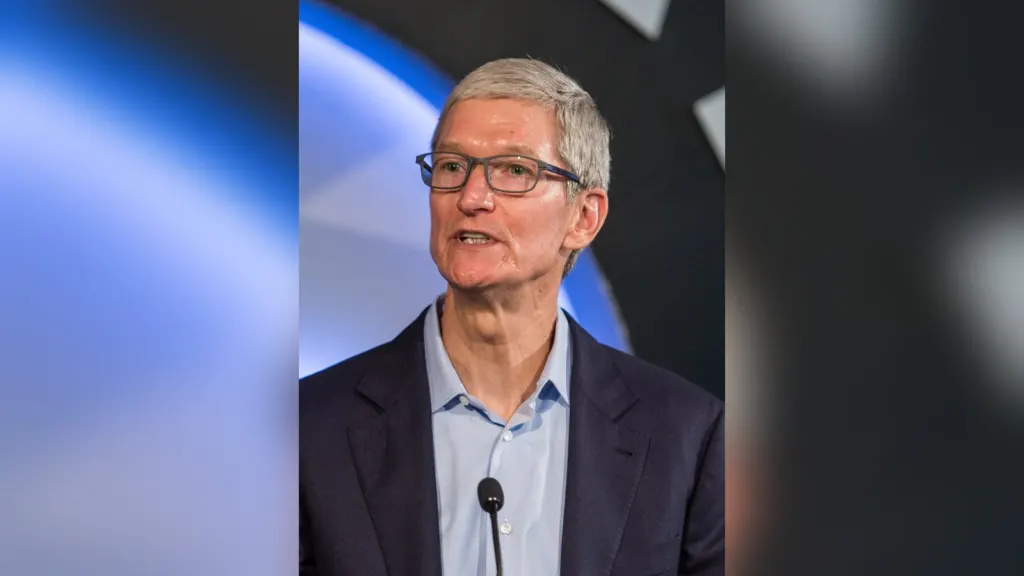
Tim Cook at an event in Austin, Texas, in 2017 Photo: Austin Community College / Wikimedia Commons, CC BY 2.0
Tim Cook, the chief executive of Apple, has about four months left in the job. On April 20, 2026, the company announced that Cook, 65, will hand the CEO role to John Ternus, its head of hardware engineering, on September 1. Cook will stay on as executive chairman.
The handover ends a run of nearly 15 years, one that began in the shadow of Apple’s co-founder, Steve Jobs.
From Alabama to Apple
Timothy Donald Cook was born November 1, 1960, in Mobile, Alabama, and grew up in nearby Robertsdale. His father, Donald, worked in a shipyard. His mother, Geraldine, worked at a pharmacy. He finished Robertsdale High School as salutatorian in 1978, then earned a bachelor’s degree in industrial engineering from Auburn University in 1982 and an MBA from Duke University in 1988.
His early career was in operations. He spent about twelve years at IBM’s personal computer business, rising to director of North American fulfillment. He then became chief operating officer of the reseller division at Intelligent Electronics, and in 1997 took a vice president’s job at Compaq overseeing corporate materials.
About six months into that role, he joined Apple. It was 1998, and Jobs had asked him to come aboard as senior vice president for worldwide operations. Cook closed factories and warehouses and shifted production to contract manufacturers. Inventory that had once sat for months was cut to days. That supply-chain discipline became his calling card inside the company.
Running the company
Cook became Apple’s chief operating officer in 2005. When Jobs took medical leaves in 2009 and 2011, Cook ran day-to-day operations. On August 24, 2011, Jobs resigned as CEO and Cook was named his successor. Jobs died on October 5 of that year.
Under Cook, Apple added AirPods, Apple Watch, AirTag and Apple Vision Pro to its product line, moved Mac computers to chips of its own design, and built up a services business. The Associated Press, in a report carried by PBS, said Apple’s market value rose by more than $3.6 trillion during his tenure, a gain tied largely to the success of the iPhone. The same report noted that Cook never fully shook the perception that he lacked Jobs’ vision.
In 2013 he hired Lisa Jackson, the former head of the Environmental Protection Agency, to help lead the company’s work on renewable energy. Cook has also been a frequent presence in Washington. He personally gave $1 million to President Donald Trump’s inaugural committee in January 2025, attended the inauguration, and on August 6, 2025, appeared at the White House to announce an additional $100 billion in U.S. investment, bringing Apple’s stated commitment to $600 billion.
Public life
In 2014, Cook wrote an essay in Bloomberg Businessweek saying he was gay, making him the first chief executive of a Fortune 500 company to say so publicly. He said in March 2015 that he planned to give his fortune to charity. He has sat on the board of Nike since 2005 and was named a Duke trustee in 2015.
His honors include the Financial Times Person of the Year designation in 2014, Fortune’s ranking as the world’s greatest leader in 2015, and the Anti-Defamation League’s Courage Against Hate award in 2018. Time put him on its 100 Most Influential People list in 2012 and 2021.
In 1996, doctors misdiagnosed him with multiple sclerosis. He later attributed the symptoms to carrying heavy luggage.
What comes next
In announcing his departure, Cook called leading Apple “the greatest privilege of my life,” according to the AP. The company said he would remain CEO through the summer. The AP compared the arrangement to those of Jeff Bezos at Amazon and Reed Hastings at Netflix, who stayed involved with their companies after leaving the top job.
Ternus, who leads hardware engineering, will be the first new Apple CEO since 2011.
Sources: Associated Press via PBS NewsHour (April 20, 2026); Wikipedia.