George Perkins Marsh, the Woodstock native whose 1864 book started American conservation
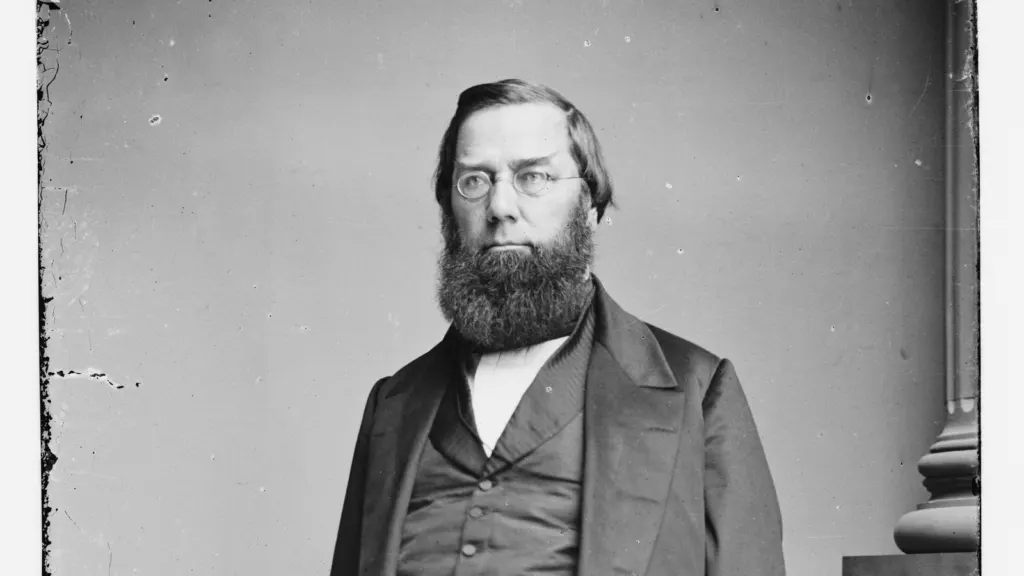
George Perkins Marsh, photographed by Mathew Brady's studio. Photo: Mathew Benjamin Brady / Levin Corbin Handy / Wikimedia Commons, public domain
Long before Vermont had a forest service, a state park system or a single conservation commission, a nearsighted lawyer from Woodstock was writing that people could wreck the land they depended on, and that they could also choose to repair it.
George Perkins Marsh made that case in Man and Nature, published in 1864. The National Park Service calls the book “a founding text of the American Conservation Movement,” and the house where Marsh grew up is now the center of Vermont’s only national historical park, which tells that story: Marsh-Billings-Rockefeller National Historical Park.
A boy who learned trees from his father
Marsh was born in Woodstock on March 15, 1801. His father, Charles Marsh, was a lawyer who served in Congress, and the family was well off. According to the Park Service’s biography, poor eyesight kept the boy indoors for much of his childhood, reading and then being read to.
He also learned the landscape from his father. In a passage the Park Service quotes, Marsh remembered riding in his father’s two-wheeled chaise as the older man pointed out trees and taught him to tell one species from another. At the top of a steep hill, his father stopped the horse and showed him how water there ran off in different directions. “Such a point was called a watershed,” Marsh wrote. “I never forgot that word.”
He went to Phillips Academy in Andover, Massachusetts, graduated from Dartmouth with highest honors at 19, read law in Burlington and passed the bar in 1825.
Congress, Constantinople and a book
His early adult life held real loss. Marsh’s first wife, Harriet Buell, and their older son had both died by 1832. He kept practicing law to support his younger son, then turned to politics in 1842. He represented Vermont in Congress as a Whig from 1843 to 1849.
President Zachary Taylor then sent him abroad as the U.S. minister to the Ottoman Empire, a post he held until 1853. The travel mattered. In the Mediterranean and the Middle East he saw hillsides stripped of trees, eroded fields and silted rivers, some of them damaged centuries earlier.
Back in Vermont, Marsh did some of the state’s first conservation work. The Park Service notes that he served as Vermont’s fish commissioner and wrote early reports on the state of its resources for the governor. His 1857 report on the artificial propagation of fish tied the decline of Vermont’s fisheries to the way its land and streams had been changed.
Then came Man and Nature. Marsh compared what he had seen in Europe and the Near East with what was happening at home, where much of Vermont’s forest had been cut for farms, sheep pasture and potash. His argument was that human change to the natural world was unavoidable, so people had a duty to decide whether that change would be for better or worse.
“All Nature is linked together by invisible bonds,” he wrote in a line the park still quotes, “and every organic creature, however low, however feeble, however dependent, is necessary to the well-being of some other among the myriad forms of life.”
The Park Service credits the book with laying groundwork for the Arbor Day movement, the first federal forest reserves and, eventually, the U.S. Forest Service.
Twenty-one years in Italy
In 1861, President Abraham Lincoln named Marsh the first U.S. minister to the new Kingdom of Italy. He held the job for 21 years and was still serving when he died at Vallombrosa, a forested abbey town east of Florence, on July 23, 1882. He is buried in the Protestant Cemetery in Rome.
The house that carried his ideas forward
Marsh’s boyhood home did not stay in the family. Frederick Billings, a Vermont native who made his fortune in California and in railroads, bought the property in 1869. He had read Man and Nature and replanted the worn-out hills behind the house with trees, using the farm as a model of careful forestry. His granddaughter Mary French Rockefeller and her husband, Laurance S. Rockefeller, later gave the estate to the public, and the national park opened in 1998.
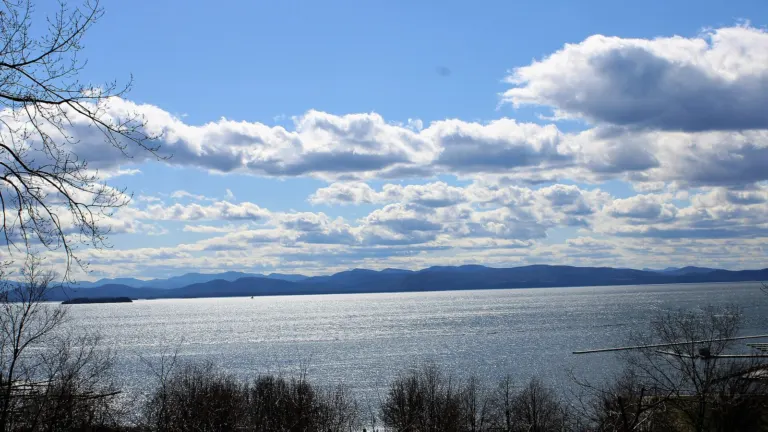
Today the park’s forest on Mount Tom is one of the oldest professionally managed woodlands in the country, and the neighboring Billings Farm & Museum still runs a working dairy, a link to the working farms we wrote about this fall. The questions Marsh raised show up in Vermont news every week, from the stalled Lake Champlain phosphorus cleanup to arguments over land use in nearly every town.
Marsh joins other Vermonters in our People section, including Madeleine Kunin. The mansion is closed for the winter, but the park’s carriage roads and trails on Mount Tom stay open to walkers and skiers year-round.
Add Vermont Daily News as a preferred source on Google (opens in a new tab)