Canadian visits to Vermont fell 28% in 2025 as visitor spending slipped to $4.1 billion
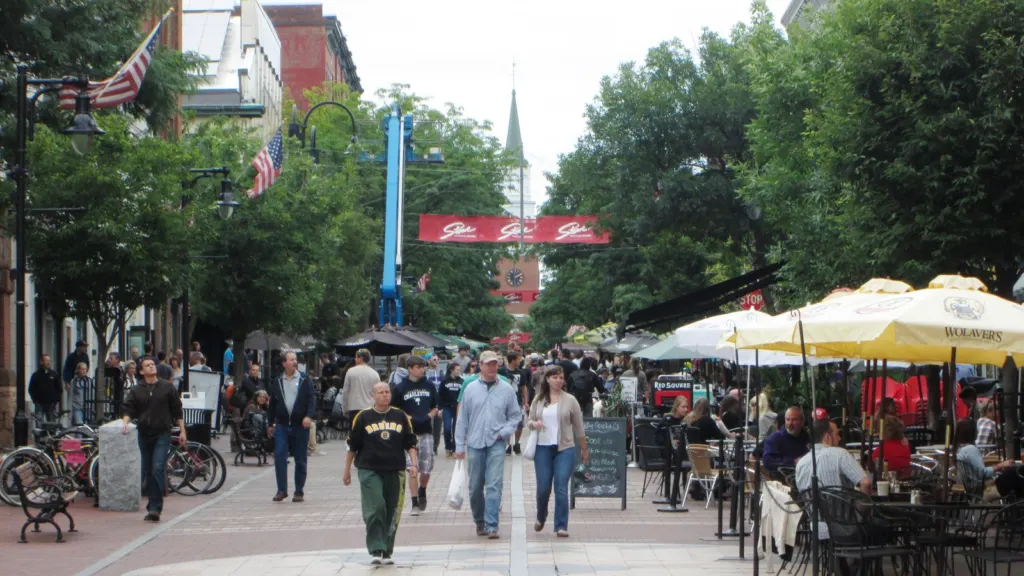
Church Street Marketplace in Burlington. Chittenden County drew 23.5% of Vermont's visitor spending in 2025. Photo: Beyond My Ken / Wikimedia Commons, CC BY-SA 4.0
Canadian visits to Vermont fell 28% in 2025 compared with 2024, and Canadian credit card spending in the state dropped 47%, according to new figures from the Vermont Department of Tourism and Marketing. The slide helped pull total visitor spending down slightly, to $4.1 billion from 15.6 million visitors.
The numbers, released Monday by the Agency of Commerce and Community Development, come from the state’s annual report on the economic impact of visitors. They give the first full-year measure of how much cross-border travel shrank, and where the money still comes from.
For a state that shares roughly 90 miles of border with Quebec, and where Montreal is closer to much of Franklin and Orleans counties than Boston is, that is a large hole.
Where the $4.1 billion went
The state counted $4.1 billion in direct visitor spending in 2025. The breakdown:
- Lodging: $1.4 billion, or 34.8%
- Food and beverages: $886.4 million, 21.5%
- Retail: $672.5 million, 16.3%
- Gasoline and other transportation: $657 million, 16%
- Recreation and entertainment: $467.1 million, 11.4%
Visitor activity supported 31,876 jobs and accounted for 8.5% of Vermont’s gross domestic product, the agency said. It generated $289.6 million in state and local taxes, which the state equates to $1,059 for every Vermont household.
Visitation and spending “trended slightly downward from 2024,” the release said, though it did not give the 2024 totals in the announcement. The full 2025 report is posted on the department’s tourism research page.
Chittenden County took the biggest hit in dollars
Chittenden County again captured the largest share of visitor spending, 23.5% of the statewide total, or about $960 million. But spending there fell 6.5% from 2024.
“2025 was a softer year for visitor spending in Chittenden County after two of our strongest years in recent history,” Cathy Davis, president of the Lake Champlain Chamber, said in the release. She pointed to the expanded terminal at Burlington’s airport, the rebuilt Main Street and new hotels as reasons for optimism, and said “sustained investment in promoting our visitor economy” is what turns that into year-round growth.
Burlington sits about 45 miles from the Highgate Springs crossing on Interstate 89, the main gateway for Quebec drivers heading south. Canadian shoppers and weekenders have long been a reliable part of that county’s retail and hotel trade, so a 47% fall in Canadian card spending shows up there first.
What the state is doing about it
“While the travel landscape continues to evolve, and factors such as international travel trends and rising costs influence consumer decisions, Vermont remains a highly desirable destination,” said Sara De Filippi, interim commissioner of the Department of Tourism and Marketing.
The department’s own brand research shows the gap it is trying to close: 79% of U.S. travelers view Vermont as appealing, but only 15% name it unprompted as a place they plan to visit. This year the state launched its first dedicated tourism brand, “State of Inspiration,” pitched as a year-round destination rather than a foliage-and-skiing stop.
Commerce Secretary Tayt Brooks said tourism supports more than 10% of Vermont’s workforce and called the agency “cautiously optimistic” about 2026.
Winter will be the next test. The ski season carries a large share of the state’s visitor spending, as our look at the ski industry’s role in the economy lays out, and fall numbers will show whether the foliage season held up. The state expects to publish 2026 data next year. More on the state’s economy is in our Business section.
Add Vermont Daily News as a preferred source on Google (opens in a new tab)