Vermont and Nova Scotia sign deal to explore bringing offshore wind power through the state
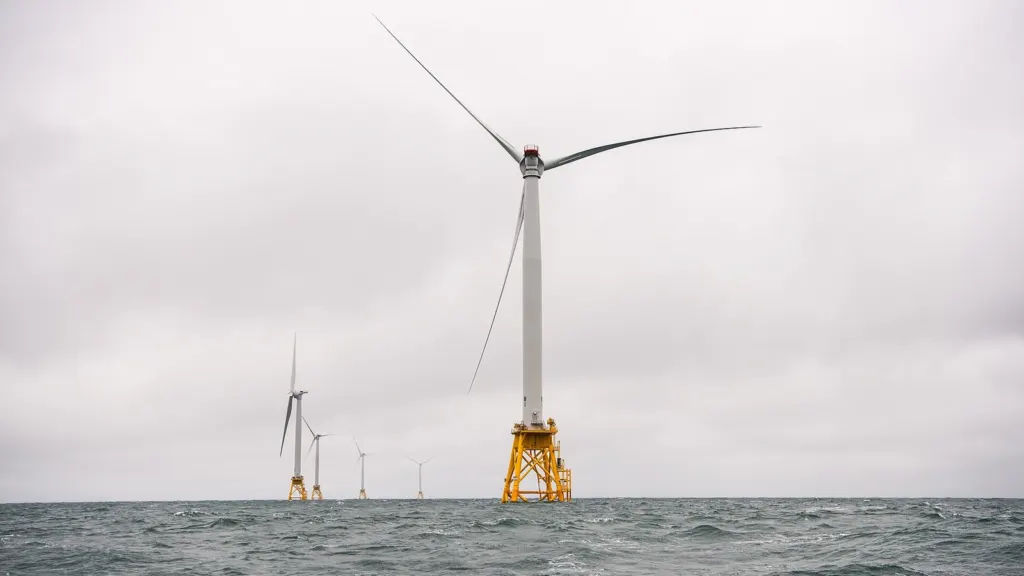
Offshore wind turbines in the Atlantic off Block Island, R.I. Photo: U.S. Department of Energy, public domain, via Wikimedia Commons.
Vermont has spent decades buying electricity from Canada, mostly in the form of Hydro-Québec power that crosses the border in Franklin County. A new agreement signed Oct. 28 looks a little farther east, at the wind off the coast of Nova Scotia.
Gov. Phil Scott and Nova Scotia Premier Tim Houston signed a three-year memorandum of understanding on transmission and regional grid integration. It sets up a framework for the two governments to share information on offshore wind, transmission planning and grid reliability, and to look at whether Nova Scotia wind power could be delivered to New England with Vermont as a link.
The agreement can be renewed for another three years, according to the Nova Scotia government.
What it does and doesn’t do
An MOU is a statement of intent. This one doesn’t commit either side to build a power line, sign a purchase contract or set a price, and it doesn’t promise Vermont ratepayers any savings. What it does is put the two governments on record as partners, which matters for a province trying to convince investors that offshore wind farms will have buyers.
“As a small state, we can’t generate affordable, clean and reliable energy alone, which is why regional partnerships are critical to reaching our goals,” Scott said in his office’s announcement. He said the deal lets the two sides explore “how to put those strengths together in a way that keeps costs down for ratepayers.”
Houston was more expansive. “Nova Scotia has one of the best offshore wind resources in the world, and partnerships like this help us turn that advantage into economic opportunity,” he said, adding that the agreement helps “advance Wind West, and position Nova Scotia to become a clean energy superpower.”
Wind West and the New England market
Wind West is the Houston government’s push to develop offshore wind at a scale far beyond what Nova Scotia itself could use, with the surplus sold to other provinces and to the northeastern United States. The province is moving toward its first offshore wind projects and has been lining up potential customers. It signed a similar agreement with Massachusetts in February, and premiers and New England governors met in August to talk about regional energy ties.
For Nova Scotia, the logic is straightforward. Offshore wind is expensive to build, and lenders want to see long-term buyers. New England, with high electricity prices and rising demand from heat pumps, electric vehicles and new industry, is the obvious market.
The harder question is how the power gets here. Offshore wind in the North Atlantic would need major new transmission to reach load centers in southern New England, and large transmission projects in the region have a long history of delays, lawsuits and cost overruns. The agreement is partly about planning for that.
The Highgate connection
Vermont’s piece of the picture runs through Highgate. The Highgate Converter, a high-voltage direct current station in Franklin County, links the New England and Québec grids and can move power in both directions. The governor’s office said a modernized converter, paired with new deliveries of Canadian power, would reinforce Vermont’s role as a connection point between the two grids.
That framing fits with how state officials have talked about energy for years. Vermont has relatively little in-state generation compared with its demand and leans on long-term contracts, including with Hydro-Québec, plus purchases from the regional market. Utilities are also working to meet the state’s updated renewable energy standard, which ramps up requirements for renewable and new local power over the next decade. Any source that is clean, firm and reasonably priced gets attention.
Offshore wind is not firm in the way hydro is, since output varies with the weather. But Nova Scotia’s wind resource is strong in winter, when New England’s grid is most stressed and natural gas prices spike. That seasonal match is one reason regional planners have shown interest.
What to watch
The near-term work under the MOU is mostly staff-level: sharing data, comparing transmission studies and coordinating with grid operator ISO New England and with Canadian utilities. Any actual power purchase would have to go through Vermont utilities and, ultimately, the Public Utility Commission, which reviews long-term contracts for cost and need.
Ratepayers shouldn’t expect to see a line item from Nova Scotia on their bills anytime soon. The agreement’s three-year term is about the length of time it takes just to get serious transmission planning off the ground. The full text of the MOU is posted on the governor’s website.