Five weeks after delegation’s letter, no word on Bethel fish hatchery’s future
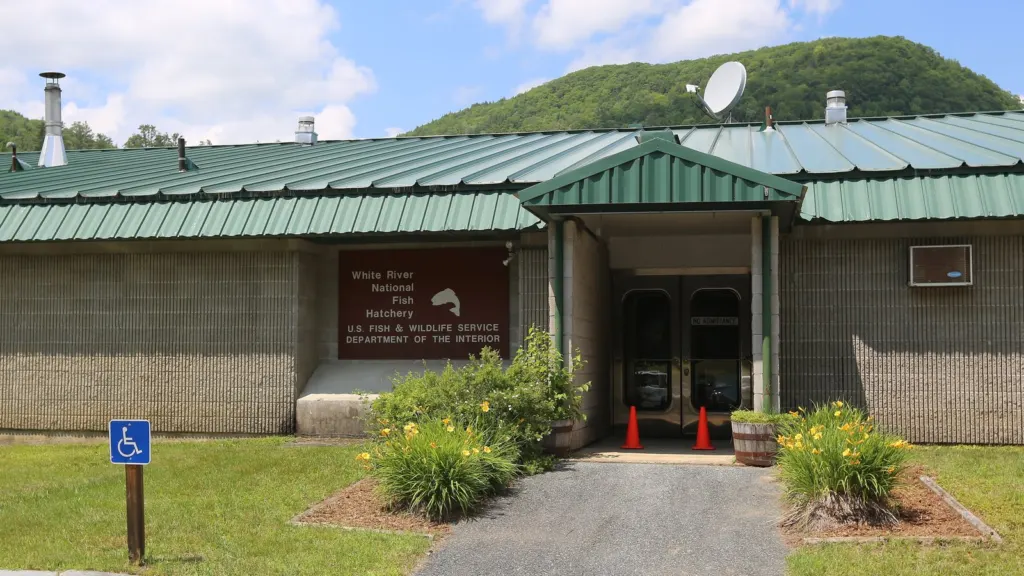
The White River National Fish Hatchery in Bethel. Photo: US Fish and Wildlife Service Northeast, public domain, via Wikimedia Commons.
The federal hatchery in Bethel that raises lake trout and salmon for Lake Champlain is slated to go inactive, and five weeks after Vermont’s congressional delegation asked for an explanation, the U.S. Fish and Wildlife Service still has not said publicly how the work would be covered.
The plan to put the White River National Fish Hatchery on inactive status came to light in an Oct. 7 letter (summarized in a release from Welch’s office) to Fish and Wildlife Service Director Brian Nesvik from Sens. Peter Welch, Chuck Schumer, Bernie Sanders and Kirsten Gillibrand and Rep. Becca Balint. They asked the agency to reverse the decision and to brief their staffs by Oct. 30.
As of Nov. 12, federal officials had not publicly explained how the hatchery’s work would be handled after it shuts down, The White River Valley Herald reported in a story republished by VTDigger. Hatchery staff told the paper they had been told to send questions to the agency.
What the Bethel hatchery does
Atlantic salmon and lake trout had vanished from Lake Champlain by around 1900, the delegation’s letter says, amid runoff from settlement and dam construction. Vermont and New York began working to restore them in 1972, and the White River hatchery opened in 1984 to give that effort federal backing. The letter says the work has “only grown more critical since the introduction of aquatic invasive species like sea lamprey.”
Tropical Storm Irene badly damaged the hatchery in 2011. It stayed closed until a $2.4 million renovation let it reopen in 2017, and during those years the Dwight D. Eisenhower National Fish Hatchery in North Chittenden picked up its work.
The letter credits the restoration program with results that took decades to show up. It cites the first wild-hatched Atlantic salmon fry found in the Winooski River in 150 years, in 2016; the most salmon counted at the Chase Mill hydroelectric dam on the Winooski in 30 years, in 2023; and a drop in sea lamprey wounding of Atlantic salmon from 79% at the height of the infestation to 6% in 2022.
Why the state is worried
Vermont’s five state hatcheries run separately from the two federal ones, but the agencies share the work under an agreement. Dylan Sickles, fish culture operations manager for the Vermont Fish & Wildlife Department, told The Herald the state hatcheries are already full.
The White River hatchery supplies brook trout eggs to the state and holds a lake trout broodstock line whose eggs go to Eisenhower for stocking other Vermont lakes. Moving that work to North Chittenden would mean putting fish “in the tanks that are already occupied by other fish,” Sickles told the paper. “There aren’t empty tanks laying around anywhere.”
Lake trout have begun reproducing on their own in Lake Champlain, which has let the state step back from its own broodstock program. Sickles told The Herald that a backup supply still matters because conditions change, and he pointed to the round goby, a small invasive fish that eats trout and salmon eggs and may be moving toward the lake.
The lawmakers also pointed to the budget. In fiscal 2026, they wrote, Congress appropriated $79 million for National Fish Hatchery System operations and another $24.5 million for maintenance and equipment, nearly $3.5 million more than the year before.
The Fish and Wildlife Service has not said when the inactive status would take effect or whether the Oct. 30 briefing took place. For more on the lake, see our report on the EPA’s warning that the Lake Champlain cleanup is off track and the rest of our Energy & Environment coverage.
Add Vermont Daily News as a preferred source on Google (opens in a new tab)