Montpelier’s Country Club Road plan: about 108 homes, no move-ins before 2029
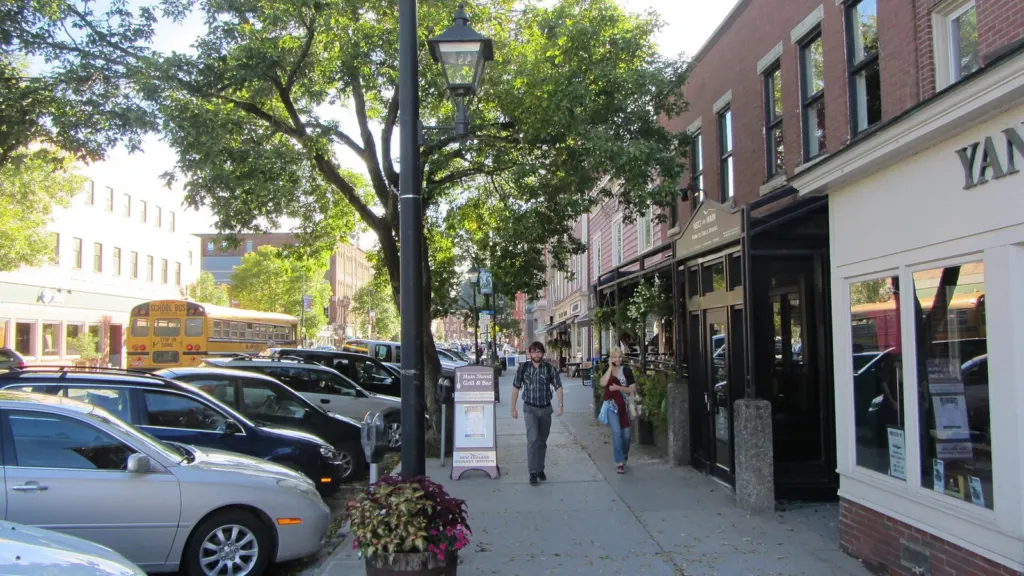
Main Street in downtown Montpelier. Photo: David Wilson, CC BY 2.0, via Wikimedia Commons.
Montpelier now has a developer and a rough plan for the former golf course it bought four years ago to ease its housing shortage. Nobody should expect to move in before 2029.
The City Council voted unanimously on Oct. 14 to approve a non-binding letter of intent with DEW Properties, according to the city’s project page. The letter names DEW as the city’s partner on the 138-acre Country Club Road site and sets up talks on a formal development agreement. The city’s schedule had targeted Oct. 19 for that agreement. It hasn’t been signed.
DEW’s first phase would put about 108 homes on roughly 20 buildable acres along the property’s lower ridge, development coordinator Robert Wells told VTDigger this week. He said construction likely won’t start until about 2028, with residents arriving in 2029 or 2030.
Before any of that, a market study has to show the project can work. DEW expects results by the end of the year. If the numbers come back weak, the size, materials or timeline could change, and the letter of intent lets either side walk away if they can’t agree on financial terms.
There is more on the list. The site needs cleanup for old golf course pesticide contamination, local zoning review and an Act 250 permit from the state. Wells estimated that permitting and due diligence could take four to 12 months. The city expects to spend about $8 million bringing water, sewer and roads to the land and has lined up grants to cover it, including $3 million from the Northern Border Regional Commission, Planning Director Mike Miller told VTDigger.
DEW works in Vermont, New Hampshire and Maine. In Montpelier it built the apartments above the downtown Transit Center, and it worked on Barre City Place. Barre’s council picked the firm in June for Prospect Heights, a development of about 100 homes off Prospect Street, The Bridge reported.
Montpelier chose DEW over three other New England developers after a process that began with a request for qualifications in late 2025. A council subcommittee narrowed the field to DEW and New Hampshire-based Chinburg Properties and voted July 10 to recommend DEW. Its decision memo said DEW’s plan best balanced housing with keeping the site’s natural and recreation areas, and phased infrastructure spending to match demand.
The purchase itself was a close call. Voters approved borrowing up to $2 million for the land on Town Meeting Day in 2022, 1,205 to 1,021. An earlier city master plan sketched as many as 292 homes across apartment buildings and townhouses on about 14% of the property, with space set aside for recreation, trails and conservation. DEW’s 108 units would be a first phase.
The project fits a statewide pattern of towns trying to add homes on land they control. For a look at the size of the gap, see our breakdown of what the state’s housing data shows.
Add Vermont Daily News as a preferred source on Google (opens in a new tab)