UVM launches a Center of Excellence in Modeling Complexity
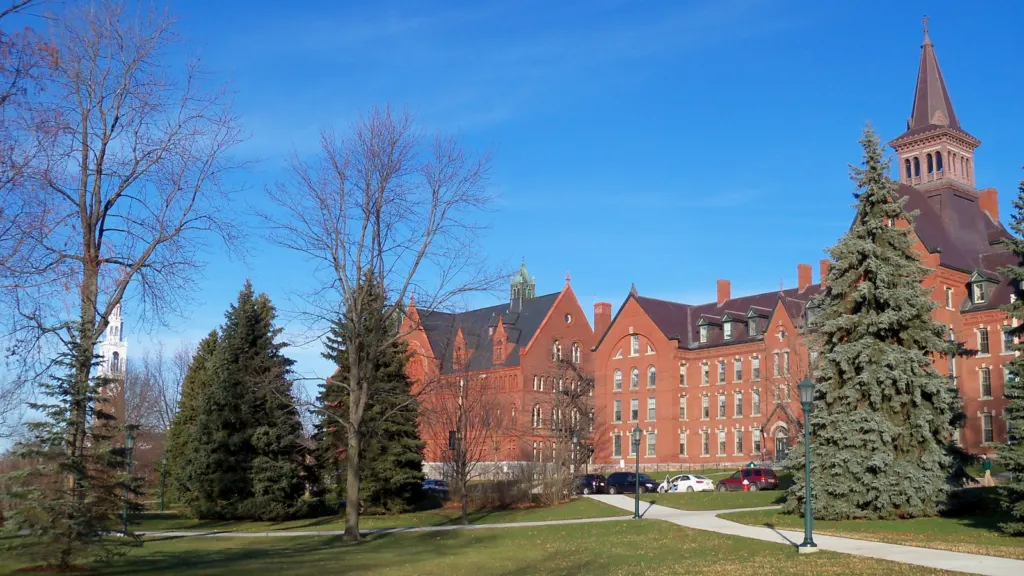
A view across the University of Vermont campus in Burlington, home of the Vermont Complex Systems Institute. Photo: AlexiusHoratius, CC BY-SA 3.0, via Wikimedia Commons.
The University of Vermont on Nov. 10 launched a Center of Excellence in Modeling Complexity, a new research center at the Vermont Complex Systems Institute that will focus on predicting how change moves through interconnected systems.
The university said the center will be led by Laurent Hébert-Dufresne, a professor of computer science, and was started with seed funding from the institute in collaboration with the Translational Global Infectious Disease Research Center and the College of Engineering and Mathematical Sciences. Researchers from across disciplines will work on mathematical, computational and data-driven models of how change spreads, from infectious disease and ecological disturbances to information, financial shocks and new technologies.
“Our greatest challenges cannot be understood through a single lens,” Hébert-Dufresne said. “Complex systems are not merely complicated; they are fundamentally interconnected, woven and inseparable.” He said the center would build frameworks for understanding how crises appear and cascade, how solutions spread, and how governance can adapt, while training researchers to work across fields.
Initial priorities, the announcement said, include predictive models for emerging infectious diseases and public health threats; resilience in communities facing environmental and economic change; the dynamics of information ecosystems, trust and collective behavior; interconnected risks in social, ecological and technological systems; next-generation AI, network science and computational approaches to decision-making; and applications of complexity science in policy, industry and public service.
Peter Sheridan Dodds, director of the Vermont Complex Systems Institute, called Hébert-Dufresne “a scientific powerhouse” with “a wonderful ability to uncover deep connections between seemingly unrelated phenomena.” Kirk Dombrowski, UVM’s vice president for research and economic development, said his leadership “will further position Vermont as a global hub for complexity science and predictive modeling.”
Hébert-Dufresne is a core faculty member of the institute, an external faculty member at the Santa Fe Institute, and founding editor-in-chief of the Nature Portfolio journal npj Complexity. In 2026 he received the German Physical Society’s Young Scientist Award for Socio- and Econophysics and the Network Science Society’s Erdős-Rényi Prize, the university said. The center will also serve as a training hub spanning mathematics, computer science, data science, public health, environmental systems and the social sciences.
Add Vermont Daily News as a preferred source on Google (opens in a new tab)