Snowflake Bentley’s cameras are in Jericho’s Old Red Mill, and the exhibit is free
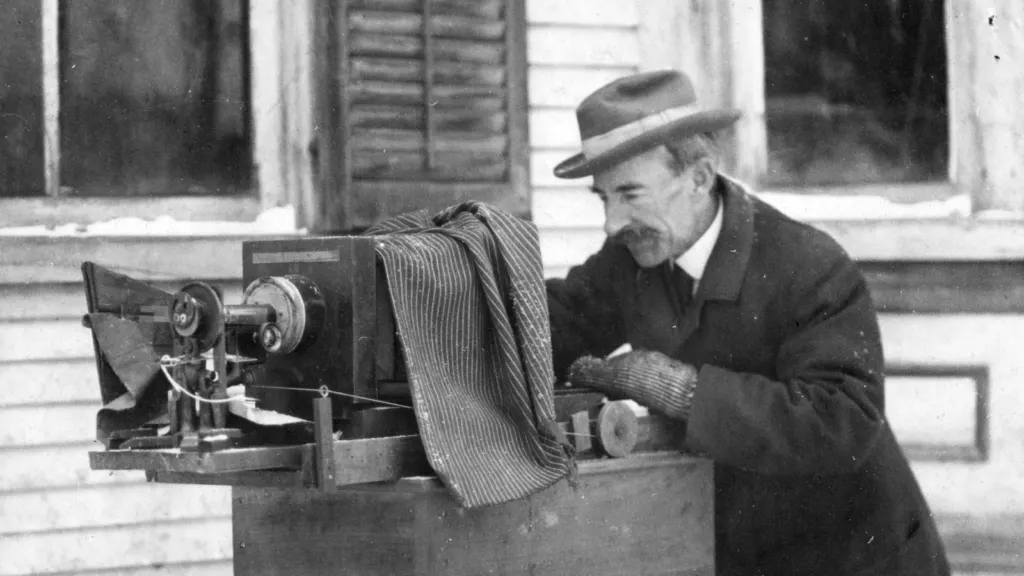
Wilson "Snowflake" Bentley with his camera at his Jericho farm. Photo: Unknown authorUnknown author / Wikimedia Commons, public domain
On Jan. 15, 1885, a 19-year-old Jericho farm boy pointed a bellows camera fitted to a microscope at a single snow crystal and made the first photograph of one. Wilson Bentley spent the next 46 winters doing it again, more than 5,000 times, on the family farm where he lived his whole life.
Most people know the phrase that came out of that work, that no two snowflakes are alike. Fewer know that Bentley’s own cameras, microscopes and prints are on display a few miles from his farm, in a 19th-century grist mill on the Browns River, and that the exhibit is free.
With the first real snow of the season arriving in the mountains, here is who Bentley was and how to see what he left behind.
A farmer with a microscope
Bentley was born in Jericho on Feb. 9, 1865, and farmed there all his life, according to the Jericho Historical Society. His interest was the weather in all its small forms: rain, dew and frost as well as snow.
He never found two snow crystals the same. “Under the microscope, I found that snowflakes were miracles of beauty; and it seemed a shame that this beauty should not be seen and appreciated by others,” Bentley wrote in 1925, in a passage the society quotes on its official Bentley site. “When a snowflake melted, that design was forever lost.”
The work took him well beyond Jericho. His photomicrographs were bought by colleges and universities around the world, and his writing appeared in Scientific American, National Geographic and a National Weather Service research journal. In November 1931, McGraw-Hill published “Snow Crystals,” the book he produced with Weather Bureau physicist William J. Humphreys. It is still in print.
Bentley did not live to see much of its reception. He died at the family farmhouse on Dec. 23, 1931, a month after the book came out. The society notes that when he gave a talk on his work in Jericho in the early 1900s, six townspeople showed up. In 2015, nearly 300 came to a symposium marking his 150th birthday.
What is in the Old Red Mill
The exhibit sits on the first floor of the Old Red Mill, formally Chittenden Mills, which the society says was declared a National Historic Site in 1972. The mill was converted to a stone grist mill in the 1850s and, after an 1880s expansion, was reported to be the first mill in New England to use the roller milling process. It stopped grinding grain in 1945. Jericho voters bought it at the 1973 town meeting and rented it to the historical society, and a 1975 vote handed the building to the society.
The Bentley room holds his actual cameras and microscopes, his own photographs of snowflakes and other precipitation, a quilt sewn by his mother and a video on his life and work. Guided tours led by a Bentley relative can be arranged by appointment by emailing the society. The same floor houses the society’s museum of Jericho’s water-powered mills and a craft shop.
Hours this winter
The mill at 4A Red Mill Drive is open Monday through Saturday, 11 a.m. to 4 p.m., from April through December, and is also open Sundays from Thanksgiving through Christmas, according to the society’s hours page. From January through March, hours drop to Thursday through Saturday, 11 a.m. to 4 p.m. It is closed Christmas, Dec. 31 and Jan. 1.
The exhibit and shop are run by volunteers, and the society asks anyone driving a long way to call ahead at 802-899-3225.
Bentley belongs on a short list of Vermonters whose work outlasted their own reputations at home, alongside Woodstock’s George Perkins Marsh. More profiles are in our People section, and if the snow has you heading outdoors, our guide to cutting a Christmas tree in the Green Mountain National Forest has the permit details.
His birthday, Feb. 9, falls during the mill’s winter schedule, on a Tuesday this coming year, so plan a visit on a Thursday, Friday or Saturday that week.
Add Vermont Daily News as a preferred source on Google (opens in a new tab)